
The Latest Kitchen Design Dilemma: Where Does the Robot Hoover Go?
Every few years, kitchen design throws up a new little puzzle.
Not long ago, it was all about hiding bins without sacrificing accessibility. Then came the rise of integrated coffee machines; suddenly, everyone wanted barista-level brewing without cluttering the worktop. Now, a quieter, slightly more futuristic challenge is making its way into design conversations.
Where does the robot hoover live?
It might sound trivial at first, but it is becoming a genuine consideration in modern kitchen planning. More and more households now rely on robot vacuums as part of their daily routine. They move effortlessly around the home, keeping things clean with minimal effort, until they need to return to their docking station.
Not long ago, it was all about hiding bins without sacrificing accessibility. Then came the rise of integrated coffee machines; suddenly, everyone wanted barista-level brewing without cluttering the worktop. Now, a quieter, slightly more futuristic challenge is making its way into design conversations.
Where does the robot hoover live?
It might sound trivial at first, but it is becoming a genuine consideration in modern kitchen planning. More and more households now rely on robot vacuums as part of their daily routine. They move effortlessly around the home, keeping things clean with minimal effort, until they need to return to their docking station.
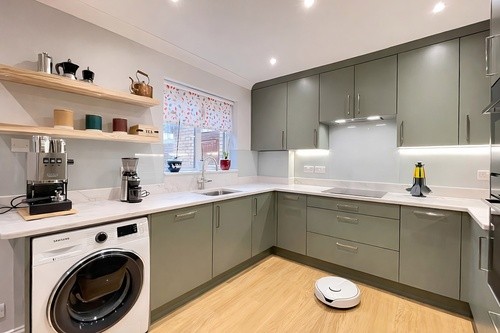
And that is where the issue begins.
The dock is rarely something you want on show, especially in a carefully designed kitchen where every detail has been considered. So naturally, clients are starting to ask:
Can it be hidden while still working properly?
The dock is rarely something you want on show, especially in a carefully designed kitchen where every detail has been considered. So naturally, clients are starting to ask:
Can it be hidden while still working properly?
Designing with Robots in Mind
The good news is that we’re already finding clever, practical ways to incorporate these devices without compromising on that much-loved minimalist style.
One approach is to integrate a small docking space into the end of a run of base cabinets. This keeps the robot accessible while tucking it neatly out of the main visual line. It is subtle, functional, and works particularly well in open plan spaces.
Another solution is to create a low, open recess within a utility room or pantry. This gives the robot a designated “home” that is out of sight but still easy to access. It also keeps the kitchen itself feeling clean and uncluttered.
In larger kitchens, we are even seeing bespoke “robot garages” – discreet compartments hidden behind push-to-open panels. These offer a fully concealed option, ideal for those who want a completely seamless look.
What needs to be considered?
As simple as it sounds, there are a few important things you need to consider to get this right:
It is not just about tucking it out of sight; it still needs to work exactly as it should.
One approach is to integrate a small docking space into the end of a run of base cabinets. This keeps the robot accessible while tucking it neatly out of the main visual line. It is subtle, functional, and works particularly well in open plan spaces.
Another solution is to create a low, open recess within a utility room or pantry. This gives the robot a designated “home” that is out of sight but still easy to access. It also keeps the kitchen itself feeling clean and uncluttered.
In larger kitchens, we are even seeing bespoke “robot garages” – discreet compartments hidden behind push-to-open panels. These offer a fully concealed option, ideal for those who want a completely seamless look.
What needs to be considered?
As simple as it sounds, there are a few important things you need to consider to get this right:
- Clear access – the robot needs an unobstructed path in and out
- Power supply – a nearby socket is, of course, essential for the docking station
- Sensor visibility – the unit needs enough open space to recognise and return to its base
- Floor continuity – keeping the floor level helps your robot move in and out without getting stuck
It is not just about tucking it out of sight; it still needs to work exactly as it should.
A Small Detail that Makes a Big difference
At first glance, this might feel like a minor detail. But it is exactly this kind of thinking that elevates a kitchen from simply looking good to genuinely working well for everyday life.
The way we use our homes is constantly evolving. Technology is becoming more integrated, more subtle, and more expected. Good kitchen design needs to keep up, quietly accommodating these changes without making them feel like an afterthought.
Because in the end, the best kitchens are not just designed for how they look.
They are designed for how people live.
And occasionally, how their robots do too.
The way we use our homes is constantly evolving. Technology is becoming more integrated, more subtle, and more expected. Good kitchen design needs to keep up, quietly accommodating these changes without making them feel like an afterthought.
Because in the end, the best kitchens are not just designed for how they look.
They are designed for how people live.
And occasionally, how their robots do too.

Recent
Home Bars & Coffee Stations | Kitchen Design Ideas Edinburgh
September 18th, 2026
Bold Statement Worktops: How to Make Your Kitchen Stand Out
September 3rd, 2026
“I’ve Been Saving for This for Five Years, and I Just Want It Right.”
August 13th, 2026
Why We’re Loving the Japandi Kitchen Trend
July 29th, 2026
The Real Cost of a “Cheap” Kitchen
July 17th, 2026
Archive
2026
February
March
May
June
July
2025
January
February
June
August
September
2024
September
2023
July
August
2022
February
May
September
October
2021
February
March
No Comments